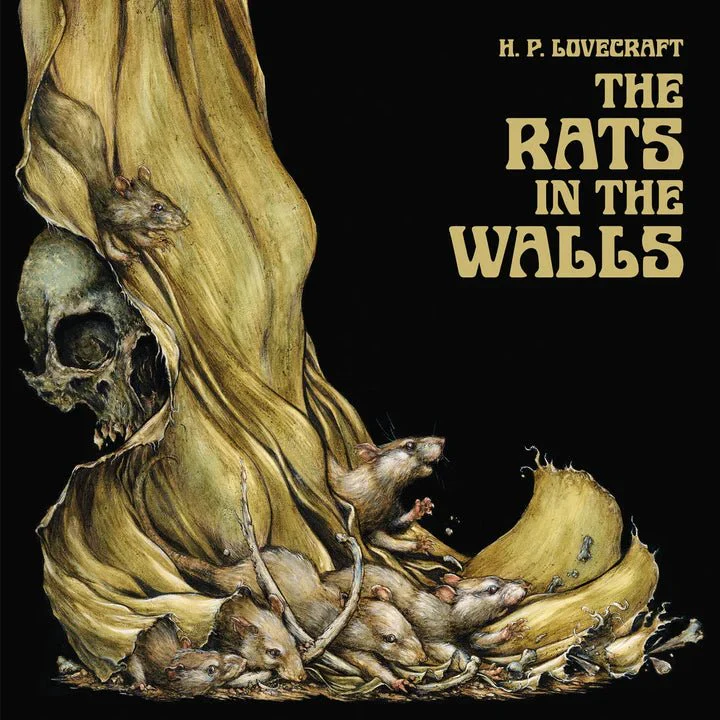
H.P. Lovecraft's The Rats in the Walls - Read by Andrew Leman, Score by Anima Morte (2x Vinyl LP)
Crimson with black swirl vinyl variant
Details:
* Full, unabridged reading of Lovecraft's masterpiece.
* Limited pressing on 150 gram vinyl
* Printed on our deluxe heavy weight tip-on gatefold jacket
* Includes an 4 pg booklet with new liner notes by weird fiction scholar S. T. Joshi and Anima Morte
* Includes a 24" x 36" poster
* Newly commissioned art by Jeremy Hush
An excerpt from S. T. Joshi's liner notes:
"“The Rats in the Walls,” the longest of Lovecraft’s tales by far to date (aside from the episodic stories “Herbert West—Reanimator” and “The Lurking Fear,” written on commission for Home Brew), is similarly the broadest in scope and the most meticulously written. It is, in one sense, the pinnacle of his work in the Gothic/Poe-esque vein (it is, in effect, his “Fall of the House of Usher”), but in another sense it is very much a work of his own in its adumbration of such central themes as the influence of the past upon the present, the fragility of human reason, the baleful call of ancestry, and the ever-present threat of a reversion to primitive barbarism. It represents an exponential leap in quality from his past work, and he would produce nothing so good until “The Call of Cthulhu” in 1926.
The somewhat curious reference to Nyarlathotep toward the end—when the narrator, crazed by what he has seen, believes that the rats are “determined to lead me on even unto those grinning caverns of earth’s centre where Nyarlathotep, the mad faceless god, howls blindly in the darkness to the piping of two amorphous idiot flute-players”—ties the story, however tangentially, to the Cthulhu Mythos. This baleful god, emerging out of the depths of Egypt and bearing the likeness of a Pharaoh, was first cited in the prose-poem “Nyarlathotep” (1920), which was itself based on a dream Lovecraft had only a short time before. In that earlier story Nyarlathotep is by means faceless, and Lovecraft may have been thinking of the hideous night-gaunts—creatures he also dreamed, as early as 1896, when he was five years old—who are indeed (as he states in a letter) “black, lean, rubbery things with bared, barbed tails, bat-wings, and no faces at all!”
The story had a peculiar and unexpected sequel. Shortly after writing it in the fall of 1923, Lovecraft discussed with Long one possible drawback about using some Celtic words (lifted, as I’ve mentioned, directly from Fiona Macleod’s “The Sin-Eater”) at the end of the story: “The only objection to the phrase is that it’s Gaelic instead of Cymric as the south-of-England locale demands. But as with anthropology—details don’t count. Nobody will ever stop to note the difference.”
Lovecraft was wrong on two counts. First, the notion that the Gaels arrived first in Britain and were driven north by the Cymri is now seriously doubted by historians and anthropologists; second, someone did note the difference. When “The Rats in the Walls” was reprinted in Weird Tales for June 1930, a young writer wrote to the editor, Farnsworth Wright, asking whether Lovecraft was adhering to an alternate theory about the settling of Britain. Wright felt that the letter was interesting enough to pass on to Lovecraft. It was in this way that Lovecraft came into contact with Robert E. Howard. Much of their early correspondence, which lasted until Howard’s death in 1936, concerned arcane points of history, ethnography, and related matters. Over the course of their six-year acquaintance they generated letters that are among the richest and most revealing that either author wrote.
“The Rats in the Walls” has rightly been one of Lovecraft’s most popular stories. Readers have sensed that it is not only a nearly flawless instance of the short story but one that features a depth and complexity that foreshadow the even more substantial tales of his last decade of writing."
We can easily say that Anima Morte has brought the Spoken Arts to a whole new level with this production. Here's a list of instruments used:
Crimson with black swirl vinyl variant
Details:
* Full, unabridged reading of Lovecraft's masterpiece.
* Limited pressing on 150 gram vinyl
* Printed on our deluxe heavy weight tip-on gatefold jacket
* Includes an 4 pg booklet with new liner notes by weird fiction scholar S. T. Joshi and Anima Morte
* Includes a 24" x 36" poster
* Newly commissioned art by Jeremy Hush
An excerpt from S. T. Joshi's liner notes:
"“The Rats in the Walls,” the longest of Lovecraft’s tales by far to date (aside from the episodic stories “Herbert West—Reanimator” and “The Lurking Fear,” written on commission for Home Brew), is similarly the broadest in scope and the most meticulously written. It is, in one sense, the pinnacle of his work in the Gothic/Poe-esque vein (it is, in effect, his “Fall of the House of Usher”), but in another sense it is very much a work of his own in its adumbration of such central themes as the influence of the past upon the present, the fragility of human reason, the baleful call of ancestry, and the ever-present threat of a reversion to primitive barbarism. It represents an exponential leap in quality from his past work, and he would produce nothing so good until “The Call of Cthulhu” in 1926.
The somewhat curious reference to Nyarlathotep toward the end—when the narrator, crazed by what he has seen, believes that the rats are “determined to lead me on even unto those grinning caverns of earth’s centre where Nyarlathotep, the mad faceless god, howls blindly in the darkness to the piping of two amorphous idiot flute-players”—ties the story, however tangentially, to the Cthulhu Mythos. This baleful god, emerging out of the depths of Egypt and bearing the likeness of a Pharaoh, was first cited in the prose-poem “Nyarlathotep” (1920), which was itself based on a dream Lovecraft had only a short time before. In that earlier story Nyarlathotep is by means faceless, and Lovecraft may have been thinking of the hideous night-gaunts—creatures he also dreamed, as early as 1896, when he was five years old—who are indeed (as he states in a letter) “black, lean, rubbery things with bared, barbed tails, bat-wings, and no faces at all!”
The story had a peculiar and unexpected sequel. Shortly after writing it in the fall of 1923, Lovecraft discussed with Long one possible drawback about using some Celtic words (lifted, as I’ve mentioned, directly from Fiona Macleod’s “The Sin-Eater”) at the end of the story: “The only objection to the phrase is that it’s Gaelic instead of Cymric as the south-of-England locale demands. But as with anthropology—details don’t count. Nobody will ever stop to note the difference.”
Lovecraft was wrong on two counts. First, the notion that the Gaels arrived first in Britain and were driven north by the Cymri is now seriously doubted by historians and anthropologists; second, someone did note the difference. When “The Rats in the Walls” was reprinted in Weird Tales for June 1930, a young writer wrote to the editor, Farnsworth Wright, asking whether Lovecraft was adhering to an alternate theory about the settling of Britain. Wright felt that the letter was interesting enough to pass on to Lovecraft. It was in this way that Lovecraft came into contact with Robert E. Howard. Much of their early correspondence, which lasted until Howard’s death in 1936, concerned arcane points of history, ethnography, and related matters. Over the course of their six-year acquaintance they generated letters that are among the richest and most revealing that either author wrote.
“The Rats in the Walls” has rightly been one of Lovecraft’s most popular stories. Readers have sensed that it is not only a nearly flawless instance of the short story but one that features a depth and complexity that foreshadow the even more substantial tales of his last decade of writing."
We can easily say that Anima Morte has brought the Spoken Arts to a whole new level with this production. Here's a list of instruments used:
Description
Crimson with black swirl vinyl variant
Details:
* Full, unabridged reading of Lovecraft's masterpiece.
* Limited pressing on 150 gram vinyl
* Printed on our deluxe heavy weight tip-on gatefold jacket
* Includes an 4 pg booklet with new liner notes by weird fiction scholar S. T. Joshi and Anima Morte
* Includes a 24" x 36" poster
* Newly commissioned art by Jeremy Hush
An excerpt from S. T. Joshi's liner notes:
"“The Rats in the Walls,” the longest of Lovecraft’s tales by far to date (aside from the episodic stories “Herbert West—Reanimator” and “The Lurking Fear,” written on commission for Home Brew), is similarly the broadest in scope and the most meticulously written. It is, in one sense, the pinnacle of his work in the Gothic/Poe-esque vein (it is, in effect, his “Fall of the House of Usher”), but in another sense it is very much a work of his own in its adumbration of such central themes as the influence of the past upon the present, the fragility of human reason, the baleful call of ancestry, and the ever-present threat of a reversion to primitive barbarism. It represents an exponential leap in quality from his past work, and he would produce nothing so good until “The Call of Cthulhu” in 1926.
The somewhat curious reference to Nyarlathotep toward the end—when the narrator, crazed by what he has seen, believes that the rats are “determined to lead me on even unto those grinning caverns of earth’s centre where Nyarlathotep, the mad faceless god, howls blindly in the darkness to the piping of two amorphous idiot flute-players”—ties the story, however tangentially, to the Cthulhu Mythos. This baleful god, emerging out of the depths of Egypt and bearing the likeness of a Pharaoh, was first cited in the prose-poem “Nyarlathotep” (1920), which was itself based on a dream Lovecraft had only a short time before. In that earlier story Nyarlathotep is by means faceless, and Lovecraft may have been thinking of the hideous night-gaunts—creatures he also dreamed, as early as 1896, when he was five years old—who are indeed (as he states in a letter) “black, lean, rubbery things with bared, barbed tails, bat-wings, and no faces at all!”
The story had a peculiar and unexpected sequel. Shortly after writing it in the fall of 1923, Lovecraft discussed with Long one possible drawback about using some Celtic words (lifted, as I’ve mentioned, directly from Fiona Macleod’s “The Sin-Eater”) at the end of the story: “The only objection to the phrase is that it’s Gaelic instead of Cymric as the south-of-England locale demands. But as with anthropology—details don’t count. Nobody will ever stop to note the difference.”
Lovecraft was wrong on two counts. First, the notion that the Gaels arrived first in Britain and were driven north by the Cymri is now seriously doubted by historians and anthropologists; second, someone did note the difference. When “The Rats in the Walls” was reprinted in Weird Tales for June 1930, a young writer wrote to the editor, Farnsworth Wright, asking whether Lovecraft was adhering to an alternate theory about the settling of Britain. Wright felt that the letter was interesting enough to pass on to Lovecraft. It was in this way that Lovecraft came into contact with Robert E. Howard. Much of their early correspondence, which lasted until Howard’s death in 1936, concerned arcane points of history, ethnography, and related matters. Over the course of their six-year acquaintance they generated letters that are among the richest and most revealing that either author wrote.
“The Rats in the Walls” has rightly been one of Lovecraft’s most popular stories. Readers have sensed that it is not only a nearly flawless instance of the short story but one that features a depth and complexity that foreshadow the even more substantial tales of his last decade of writing."
We can easily say that Anima Morte has brought the Spoken Arts to a whole new level with this production. Here's a list of instruments used: